Wednesday, April 11, 2012

Editing Counts!


If you are reading this in your email, don’t forget to click on the headline to go to my blog. If you haven’t subscribed yet, please do. And please leave a comment. If you have trouble leaving a comment, please click on the title of the post and comments should pop up at the bottom. If you don’t have one of the accounts they ask for or don’t want to use that, please use Anonymous, but let me know who you are. Thanks. I love to hear from you.

Here are a couple of links to really good things for my writer friends.

First you can get some good writing advice directly from Kurt Vonnegut’s own mouth. There are also links to advice from other great writers. I’m particularly fond of John Steinbeck’s pithy advice. Check it out. http://www.brainpickings.org/index.php/2012/04/03/kurt-vonnegut-on-writing-stories/

If you’re writing picture books, this is an excellent post: http://teazurs.blogspot.com/2011/12/picture-book-writing.html

Now, I have the pleasure of announcing the WINNERS of the giveaway from my last blog post. The first winner is Joyce Moyer Hostetter, who will receive a copy of An Elephant in the Garden, and the second winner is Elizabeth Varadan, who will receive Kaspar the Titanic Cat. Congratulations to both. Stay tuned, because I have decided this is so much fun, I will have yet another giveaway this post!

If you’ve been reading this blog for awhile, you know I do a LOT of book reviews, not only on this blog, but for the Sacramento Book Review. I work almost exclusively with middle-grade books and picture books. Once in awhile I will review an adult or YA. In the last few weeks, I’ve reviewed books written by award-winning authors that left much to be desired. One said “Newbery Honor Winner” just above the author’s name and below the title, which might leave the impression that this book was a Newbery Honor winner. Wouldn’t it be more honest to say Newbery Honor writer? And it was in 1984 – 28 years ago. I find that a little disingenuous. The second book doesn’t tout it on the cover, but on the jacket flap it describes the author as “an acclaimed poet and the Coretta Scott King Award-winning illustrator …” So the author of this book won an award for illustrating – not for writing – and he didn’t illustrate the book I reviewed. Someone else illustrated it.

Now I bring this up because both of these books were soooooo disappointing to me. Both were published in hardback by big houses in New York. And here is where I lay some of the blame. I have the impression, especially with the book mentioning the Newbery Honor, that there was little or no editing going on. I guess the editor assumed the honor-winning writer didn’t need any help. Reading that book, kids will be confused by so much, especially the overly-long list of characters who are all much the same. The book could easily have been pruned by about 30% and would have been a much better book for it. It is being sold as a book for kids 7-9 years old, but I doubt many would make it through. The other book was written in rhyme – often forced rhyme – with little metrical structure. The book came in at just over a hundred pages and is illustrated. Normally, I would read a book like that in an hour or so. It took me all day because I had to keep taking breaks due to the pounding headache it gave me. Not kidding. The sad thing is it had a great story that would have been quite wonderful written in prose. Did an editor actually look at this and okay it? I know publishing companies are cutting back in a lot of areas, but, for heaven’s sake, don’t let books go out unedited! That is not a recipe for success.

On the other hand, I’m reading wonderful early novels – books that are just knocking my socks off – some of which I’ve reviewed on this blog, like Three Rivers Rising, May B., and One for the Murphys. If you click on the titles, you will be taken to my reviews of them. This week I picked up a book – wish I could remember where I heard about it, but I can’t – that I just fell in love with. It’s called Eight Keys, and I suggest you run right out and find a copy. This is only the second book by Suzanne LaFleur, and I haven’t read her first book, but I guarantee I will read it as soon as I can. Eight Keys is simply one of the most engaging books I’ve read in a long time and ranks right up there with the other books I mentioned in this paragraph.

Elise lives with her Aunt Bessie and Uncle Hugh and has since her father died when she was three. Her mother died in childbirth. (“Oh, no,” I hear you saying. “Not another dead-mother book!” But wait. This one is really, really good!) Elise has been best friends with a neighbor boy, Franklin, for just about forever. They have lots of fun playing together. He’s really smart and a great friend. They are as comfortable as a pair of old bedroom slippers. But summer is ending and they must go off to the big middle school that is fed by four or five elementary schools.

Suzanne LaFleur
Elise is pretty nervous about all the kids she won’t know and fitting in and having lots of different teachers she doesn’t know and all those things that are scary about changing schools. She is assigned to share a locker with a girl who is pretty, popular, and a flat-out bully. She sets out to make Elise’s life a misery and is pretty successful at it. Elise and Franklin start to grow apart, and Elise does nothing to nurture their friendship. In fact, she does a lot to damage it. She also has a great deal of trouble making the academic transition to middle school, struggling with the work and giving up easily.

At home, Elise discovers a mysterious key that leads her to a journey of discovery about whom she is and helps her to do a lot of growing up.  She has a great support system of family and friends of her father who all help her find her way without doing everything for her. She is allowed to make mistakes and find herself. The cast of characters is just the right size for a middle-grade novel, each interesting and really necessary to the story. The writing is as smooth as polished granite, and the story is engaging, uplifting, and compelling. Not only will the target audience of middle graders like this book, but others will as well. I loved every word and highly recommend it. Suzanne LaFleur is a great new writer! I also suspect there was a really good editor involved who did his or her job on this one!

Now for the giveaway. I wish I had a copy of Eight Keys to give away, but I don’t. So I’m offering your choice of A) one of the best picture books I’ve ever read – Neville written by Norton Juster and illustrated by G. Brian Karas (you can read my Sacramento Book Review write-up by clicking HERE) or B) May B., the middle-grade book in verse written by Caroline Starr Rose I mentioned earlier in this post. (You can read my SBR write-up of May B. by clicking HERE.) Just leave a comment by midnight next Tuesday, April 17. You can receive an extra chance in the drawing if you post a link to my blog on Facebook or your blog. Just let me know and I’ll give you two chances in the drawing. Oh, and please tell me which book you would prefer to receive.

Remember, if you have trouble leaving a comment, click on the title of the post and it will give you just this post with a comments section on the bottom. Let the games begin!

Tuesday, April 3, 2012

Tell Me a Story -- Narration in Today's Writing. Book Reviews and a Give-Away

If you are reading this in your email, don’t forget to click on the headline to go to my blog. If you haven’t subscribed yet, please do. And please leave a comment. If you have trouble leaving a comment, please click on the title of the post and comments should pop up at the bottom. If you don’t have one of the accounts they ask for or don’t want to use that, please use Anonymous, but let me know who you are. Thanks. I love to hear from you.

First of all, for my writer friends, two great links. The first is to remind you why it’s probably a really bad idea to ask for advice on your writing: http://www.youtube.com/watch?v=sifESist1KY
If I posted this before, forgive me. I look at it now and then just ‘cause it makes me laugh out loud.

I know the SCBWI Spring Spirit Conference is coming up very soon her in the Sacramento area, and I'm sure there are spring conferences all over the place, so here is a blog post with some important reminders: http://kathytemean.wordpress.com/2012/04/02/conference-dos-and-donts2/?utm_source=feedburner&utm_medium=email&utm_campaign=Feed%3A+WritingAndIllustrating+%28Writing+and+Illustrating%29

Second order of business is WINNER, WINNER, CHICKEN DINNER!!  The winner of the drawing for my own ARC of One for the Murphys is SHANNON HITCHCOCK! Yay for Shannon. I am contacting her for a snail mail address and soon she will be reading this wonderful book. We have another give-away today, with TWO winners, so make sure you read to the end.

Today I’d like to talk about the return of narrative. For as long as I have been seriously writing, I have heard and read that we have to show, don’t tell. Dialogue and action reign over all. Narration should be nearly non-existent in our writing. Actually, I think it’s pretty good advice a lot of the time, but great writing sometimes happens when a story is told – narrated – just like stories have been told for thousands of years.

A few months ago, I reviewed a book for the Sacramento Book Review that really stuck with me. I thought about it a lot and was amazed that it was published in the publishing environment that exists today, because it is almost totally narration. That book is An Elephant inthe Garden by Michael Morpurgo. You can see my review by clicking HERE. It is a wonderful story based on a true happening from Europe in World War II. Morpurgo strays far from the original happening, but good historical fiction often does.

What is amazing to me is how Morpurgo structured the story. It begins with a woman who works as a nurse at a home for elderly people. The woman has to bring her young son Karl along one Saturday when she is working because she doesn’t have anyone to leave him with. She pretty much tells us (narration) her part of the story. While there, Karl wanders into the room of Lizzie, one of the patients. Karl protests when his mother drags him out that Lizzie was about to tell him the story of the elephant. His mother tells him there is no elephant, just the imaginings of an old woman. Lizzie asks about Karl and Karl comes to see her again. She begins to tell (narration) the story of an elephant in her garden, many years ago during World War II when she was a child in Germany and how that elephant helped her family escape from both the Nazis and the Russians at the end of the war. It is an incredible adventure and a love story all wrapped up together. Lizzie tells (narration) Karl and his mother this story over a couple of visits and there is narration by the nurse between visits to break Lizzie’s long narration.

I loved the story and the writing. It was a real treat to lose myself in the idea of simple, old-fashioned storytelling. Come on. We all love to have a good story told to us, so why is there so much writing angst about narration? Clearly, Michael Morpurgo isn’t suffering from that angst. He has tons of books published. (No. Seriously. I mean TONS. Look at his website books page by clicking where it says "books page." He has written wonderful, popular books like this one and War Horse, which I haven’t read yet, but I will. Today I read another of his books – Kaspar the Titanic Cat – and, guess what? It is TOTAL narration. I liked it every bit as much as An Elephant in the Garden. What can I say? I just love having a story told to me. I’m a kid at heart. And since Morpurgo writes books for kids, he just might be on to something.
Kaspar the Titanic Cat is a lovely story of an orphan boy who finds himself, true friendship, and a family because of a prince of a cat. It’s fanciful, but totally believable. Johnny Trott works as a bell-boy at the Savoy Hotel. He is befriended by an opera singer, Countess Kandinsky, who comes to stay at the hotel for three months with her cat Kaspar. Johnny is chosen to care for the cat, walking him during his breaks and making sure he is fed and cared for when the Countess is away at practices and performances. When the countess is killed in a traffic accident, Johnny tries to take care of Kaspar, but the cat will not eat and hardly even drinks water. He loses weight and his coat dulls. A wealthy American family, the Stantons, comes to stay at the Savoy for a couple of months prior to their up-coming trip on the wonderful, new ocean liner, the Titanic. The Stanton’s young daughter, Lizziebeth, discovers Kaspar and is able to get him to eat again. They become great friends and Lizziebeth becomes friends with Johnny as well. Johnny ends up saving her life and the Stantons reward him. When it is the time for them to leave, Johnny gives Kaspar to Lizziebeth, and the Stantons take Johnny along to the Titanic to help them settle in on the ship. Johnny decides to stow away and go to America. Remember now – this is the Titanic. This entire book is Johnny Trott telling (narration) his story.
Michael Morpurgo
Narration has its place in writing. Few writers would take on this kind of complete or nearly complete narration these days, but when done well, it works. I think Michael Morpurgo does it very well. I’d like to offer two of you the chance to see what you think. I am going to give away my gently-read copies of An Elephant in the Garden and Kaspar the Titanic Cat. You can win one of them. You will get your name in my blog hat (from which my eminently honest granddaughter Gracie will choose two names) if you leave a comment here on the blog, and tell me what you think about narration angst or anything else on your mind and which of the books you would prefer. Because I am trying to drive more traffic to my site, I will put your name in a second time if you put a link to my blog on your blog or even on Facebook and let me know that. The person whose name is chosen first will receive the book of his or her choice. The second name drawn will receive the other book. That drawing will take place next Wednesday – April 11 – so have your comments in by midnight , Tuesday, April 10. These are both wonderful books and I know you will enjoy either. So, please leave a comment and let the games begin!

Saturday, March 24, 2012

One for the Murphys Review and Give-away

Here is a little gift for all of you. It’s a link to something that is just flat funny. If you like Shakespeare, you will really love this one.


I know I’ve been posting less than usual this year, but I hope to get back to normal one of these days. I’m happy to report my husband has regained his health and the stress of his illness is gone. Yes, you can beat cancer. YAY! That said, I am going to a very important writer’s workshop next month and am under the gun to finish up some materials quickly to be ready for that, so that’s taking a lot of time. BUT, I really want to get this post up while it’s fresh in my mind. So here goes.

Now and then, I read a book that simply captures my heart. This is one. I read a review of it somewhere – wish I could remember where – and knew I wanted to read it. I corresponded with the author and suggested she have a copy sent to the Sacramento Book Review and I would try to claim it. That all worked out and, thanks to some baseball practices my grandkids had, I was able to carve out some good reading time while they worked on their skills – time I couldn’t have had if I’d been home with my research staring me in the face.

One for the Murphys is the debut novel of Lynda Mullaly Hunt, and what a debut it is! It’s categorized as a middle-grade book, but will likely become popular not only with middle-grade kids (girls more than boys, but I think boys will like it, too), but with teens and adults who appreciate great characters and excellent story-telling.

I do not suffer fools gladly, so when I find characters who are bright, clever, and funny, I am engaged. Carley Connor has all those characteristics and a wicked sarcastic edge that is icing on the cake. She is a 12-year-old girl who hasn’t had much good in her life. Most recently, she finds herself in the same hospital as her mother, both having suffered terrible beatings at the hands of Carley’s new stepfather, Dennis. The difference, we find out, is Carley has a memory that when she tried to escape from him, her mother grabbed her ankle and held her for Dennis. Wow. How bad can things get?

Carley is taken from the hospital to a foster home, a family with three young boys. Of course she believes she will simply be used as a live-in babysitter. What she finds is a woman who loves her three boys unconditionally, has a warm and loving home, and opens herself to Carley. Carley doesn’t quite know what to make of it. “I don’t belong here. I begin to think that a foster mother who smokes cigars and makes me sleep in the basement would be a relief.” But she finds herself liking the younger boys and opening herself up a bit to this place and family, keeping her defenses handy, just in case.

School is another issue. She has no friends and at first it doesn’t seem there’s much of a chance she will make any. When she is assigned to do a project with a partner – someone she can’t stand, of course – she discovers she might just have a friend after all and maybe life is getting good. But there are still trust issues and without trust, friendships can disintegrate.

Lynda Mullaly Hunt
The real core of the story though is Carley’s relationship with her foster mother, Mrs. Murphy, who seems to have a window into Carley’s very soul and ways to reach in and help her find herself and know herself.

Most of the time, it wasn’t like my mother told me I was anything—good or bad. But when Mrs. Murphy tells me I’m smart, I am. When she tells me I’m funny, I am. When she tells me how thoughtful I am, I become that way. I swear, if she told me I was a duck, I’d be checking in my high-tops for webbed feet.

The family grows on Carley and she grows on them. She even makes friends with the oldest of the three boys when she works with him on his basketball skills. She hasn’t had good experiences with men, but learns to trust Mr. Murphy, ultimately becoming close to him as well. But the only thing certain about foster care is that it’s so uncertain. It’s all turned out pretty well and Carley seems content and happy when she is faced with a most difficult decision.

I remember how my mom used to say we were the same. That the apple doesn’t fall far from the tree. I think, now, that although the apple can come from the tree that it can land on the ground and roll down a hill and end up in a totally different place.

This is a lovely novel, one that will capture you and stay with you. The biggest disappointment is that it ended. I found myself so engaged by the characters and the terrific writing and story that I simply wanted to go on reading. (Do I hear “Sequel?”)

I love this book so much I have decided I want to share it with one of you. If you leave a comment by midnight April 1st (no fooling!), I will be doing a drawing (honest granddaughter Gracie will actually choose the winner) from the names of those who comment, and I’ll send my very own gently-read advanced reader copy of One for the Murphys off to one of you (U.S. only). It won't be out until May, so this is your only way to get it NOW! So write something in the comment section and try your luck. You won’t be disappointed.

If you are reading this in your email, don’t forget to click on the headline to go to my blog. If you haven’t subscribed yet, please do. And please leave a comment. If you have trouble leaving a comment, please click on the title of the post and comments should pop up at the bottom. If you don’t have one of the accounts they ask for or don’t want to use that, please use Anonymous, but let me know who you are. Thanks. I love to hear from you.

Tuesday, February 28, 2012

News and a Review: The Fault in Our Stars by John Green


"I can't understand why a person will take a year to write a novel when he can easily buy one for a few dollars." ~ Fred Allen

I would just like to say to Fred Allen (no, I cannot really speak to the dead, but often wish I could), that if it only took a year, this would be a much easier business.

Things at our house have finally settled down a little, and I am getting back to doing some writing. My husband, Dave, has been extremely ill and now is finally on the mend. Our daughter Sara says we must now refer to him as “Lefty” since he had his right kidney (and the nasty tumor attached to it) removed. I kind of like the moniker. I’m still nursing him, but am finally able to breathe easily. We also had a roof leak in the middle of all this and had to have some pretty significant repairs on our home. Now writing is percolating back up to the top of my to-do list. It’s been a long dry spell, and I am so glad to be back to it.

I spent a lot time in the last several weeks waiting – waiting for appointments, waiting for workmen, waiting quietly for Dave to wake up and hopefully be hungry. There were weeks I was afraid to leave his side for more than a moment. Yes, he was that sick. But I filled a lot of the waiting time with reading, something for which I never seem to have enough time. Many of the books I read were for the Sacramento Book Review, but I also got to several books on my long TBR list. I will be reviewing some of those wonderful books in the coming days.(If you'd like to read some of my reviews for the Sacramento Book Review, go HERE.)

I have been kicking an idea for a book around in my head for quite awhile, and I already had a perfect title picked out – The Fault is Not in Our Stars. So imagine my chagrin when I started reading everywhere about the hot new YA, The Fault in Our Stars (an interesting twist on the original quote) by John Green. (Please click on the title, not the book cover, if you want to order the book.) I told myself, when I get my book written, no one will remember the other one, so it’s okay. But I felt compelled to read the book, and now I had the time, so I did. Let me start by saying I don’t believe this book will be easily or quickly forgotten.

It’s ironic that while I was dealing with my husband’s illness, a big part of which involved cancer, I found this amazing book about some cancer patients. And I do mean this is an AMAZING book.

Hazel Grace Lancaster, age seventeen, is a terminal cancer patient. She was diagnosed with thyroid cancer which has spread to her lungs. Her mother thinks she is depressed – Now why would she think that? – and her doctor convinces her to attend a support group for teen cancer patients. Hazel doesn’t really like going to the support group, but she does – probably more to please her mother than for any other reason. After all, her mother has put her life entirely on hold to see her daughter through to the inevitable end. Hazel’s father is also present in the book. Every time we see him, he cries. His daughter’s illness overwhelms him and he cries easily.

In the support group, Hazel has a friend named Isaac who has lost one eye to a rare eye cancer and is going to lose the other eye soon, as cancer has invaded that one as well. Isaac is angry and so sad about this impending surgery, that his pain is palpable.

Wow, I can hear you saying, now why would I want to read such a depressing book. Let me tell you, this is not in any way a depressing book. In fact, it is downright uplifting. And FUNNY. I found myself laughing out loud many, many times while reading it. And sweet. There is romance, too, in case you’d like some of that.

A new member joins the support group – Augustus Waters – who is drop-dead (probably a poor choice of words) gorgeous and seems quite fascinated with Hazel, to whom he always refers as Hazel Grace. When Gus starts to move around, we (and Hazel) find he has lost a leg to cancer. However, he is happy to say, they got it all and he is fine. Gus and Isaac are friends and soon Hazel Grace is pulled into a friendship with Gus. They share favorite books with each other and learn much about each other through those books. Hazel’s book is about a cancer patient and stops, rather than ending. It is a source of great frustration to her. Gus feels much the same. Hazel has written many times to the author, a recluse who has moved to the Netherlands, asking for resolution to questions she has. Gus feels the same after reading it, and they spend a lot of time talking about ways to contact the author.
John Green

Gus finds out Hazel Grace used up her wish (from a group like Make-a-Wish Foundation), but he has never used his. He decides the best thing to use his for is to take Hazel Grace to the Netherlands to talk to the author. Not only is it difficult to arrange to meet a reclusive author (think J. D. Salinger), but getting two cancer patients and one mother there is no easy task. Then, toss in the mother of all twists, and you have quite an extraordinary story.

Don’t wait for time to read this wonderful book. Make time. The writing is spectacular and the story is fantastic.

If you are reading this in your email, don’t forget to click on the headline to go to my blog. If you haven’t subscribed yet, please do. And please leave a comment. If you have trouble leaving a comment, please click on the title of the post and comments should pop up at the bottom. If you don’t have one of the accounts they ask for or don’t want to use that, please use Anonymous, but let me know who you are. Thanks. I love to hear from you.

Thursday, January 19, 2012

I'm Back ... With a Book Review of May B.

Hello Blog Readers. I know some of you must think I fell off the edge of the world, but I didn’t. After the craziness of the holidays, my husband was hit with some serious germs, and I have spent my time nursing and worrying. We aren’t out of the woods yet and won’t be for quite awhile, so please excuse me if my blogging is spotty over the next couple of months.

"Perfection is achieved, not when there is nothing more to add, but when there is nothing left to take away." ~ Antoine de Saint-Exupery

I ran across this quote recently and think it really speaks to writers. I am going to make a little poster of it and hang it in my office. I thought it would be a nice way to start the blog post today. I think it would be equally useful for things other than writing, like decorating and fashion design and ………., well, who knows. You might want to fill in the blank yourself. But it is a particularly appropriate quote for a review of a fine book written in verse.

Last April, I reviewed a marvelous book, Three Rivers Rising by Jaime Richards. First, it is historical fiction – well researched and a compelling story. Second, it was written in verse. I found that fascinating. The language was so spare and beautiful. If you missed the review, you can read it HERE . There is also a nice interview with Jaime HERE .

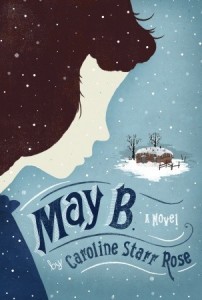
You might wonder why I am bringing up these posts from last year, but I have a reason. It is by way of introducing a brand new book, just released this month. It is also historical fiction and is also written in verse. Now I love historical fiction. I love to read it and I love to write it. My second (not yet published) novel is historical fiction, and I have some other such pieces in the pipeline. But verse? Holy Guacamole! I don’t know how people do this, but Caroline Starr Rose has done it so very nicely in her debut novel, May B.

Caroline Starr Rose
12-year-old Mavis Betterly, May B., has lived most of her life in the plains of Kansas. It is the late 1800s and May and her family live in a sod house (soddy) miles from neighbors or towns. Her best friend is her older brother Hiram, who defends May when her reading disability makes things hard for her at school. It’s a hard life and the family of four struggles. When a neighbor offers to hire May to help his new wife with cooking and housework, May’s father agrees. May doesn’t want to go, but is given no choice. She worries about missing school, especially since she has such trouble reading. Her dream is to become a teacher one day, and she knows she can’t accomplish that if she can’t go to school. Her father promises he will get her back before Christmas, but five months stretches immeasurably for May.

Mrs. Oblinger is young. May thinks she’s not much older than May is. And she is a town girl – apparently miserable in her new life. Mr. Oblinger is a kind man and tries in every way to make his new wife happy. May does her work and thinks about home and her own family.

Ma’s probably rolling dough,
Humming.
Maybe Hiram’s grinding coffee
Now that I’m not there to help.
He’s already brought the milk pail in.
When Pa gets back,
He’ll share what he heard in town.

May isn’t particularly happy or comfortable, but it’s clear she will do what she needs to do to meet the obligation her father set for her. One day, Mrs. Oblinger says she is going for a ride, but leaves a note behind saying that she is going home. When Mr. Oblinger reads the note, he takes the rifle, gets into his wagon, and tells May to not hold supper. He might be awhile.

Fear flashes inside me.
Pa never left Hiram and me without
protection.
All around me there is nothing
but the prairie and the sky.
“Silly girl,” I tell myself.
“There’s no reason to worry.”
But it takes time for my heart to slow.

May faces something few could – loneliness, fear, few supplies, wolves, and finally a huge blizzard. This is a story of courage and perseverance and resourcefulness. It is told in the clear voice of a young girl, true to the time and place of the story. It is beautifully written and a compelling read. You can easily read it in a day and I recommend you do. It is well worth your time.

Here is a link to a great book give-away you might want to check out: http://caseylmccormick.blogspot.com/2012/01/2000-follower-awesome-giveaway.html

If you are reading this in your email, don’t forget to click on the headline to go to my blog. If you haven’t subscribed yet, please do. And please leave a comment. If you have trouble leaving a comment, please click on the title of the post and comments should pop up at the bottom. If you don’t have one of the accounts they ask for or don’t want to use that, please use Anonymous, but let me know who you are. Thanks. I love to hear from you.

Sunday, December 18, 2011

Here – On Our Stage – The Fabulous Dawn Lairamore!


It's that time of year, so I'm a little slow with posts, but this one is really worth waiting for! Things will pick up after the first of the year. And I would like to wish all of you the happiest of holidays, whichever holidays you celebrate. I wish you quiet time with those you love and an absolutely fabulous new year. 

If you are reading this in your email, don’t forget to click on the headline to go to my blog. If you haven’t subscribed yet, please do. And please leave a comment. If you have trouble leaving a comment, please click on the title of the post and comments should pop up at the bottom. If you don’t have one of the accounts they ask for or don’t want to use that, please use Anonymous, but let me know who you are. Thanks. I love to hear from you.

First, some holiday gifts for my writing friends – some links that can help you out or make your writing life a little better or easier.


A lecture by Stephen J. Cannell on the three-act structure http://www.writerswrite.com/screenwriting/lecture4.htm

And now I am happy to present, for your edification and reading pleasure, an interview with Dawn Lairamore, author of two fabulous middle-grade fantasy books, Ivy’s EverAfter and Ivy and the Meanstalk. I recently did a review for Sacramento and San Francisco Book Reviews of Ivy and the Meanstalk which you can read by clicking HERE. It’s a 5-star review, of course. This is a very fun book. If you click on the book titles, it will take you to the listing where you can order the book. Clicking on the book covers, alas, will take you no where. Now, sit back, relax, and enjoy Dawn’s interview.

What did you do to prepare for writing Ivy’s Ever After and Ivy and the Meanstalk? What I mean is, did you have to do much in the way of research?

Dawn Lairamore
No, actually.  Because Ivy and Meanstalk take much of their inspiration from the familiar fairy tales that most of us know and love, there wasn’t the need for much in the way of research.  I did research little things, such as looking at diagrams of medieval castles to make such I was using the terminology of all the various parts and structures correctly, and the like.

How did you discover your fictional characters? This may sound odd about a fantasy book, but are any based on real people? I’m pretty sure I’ve met Romil somewhere along the way.

Rosi, I’m so sorry—I truly hope he wasn’t an ex-boyfriend or someone you dated, lol!

None of the characters in my books are based outright on real people, although I think bits and pieces of people I know sometimes seep in here and there.  The more dreamy, romantic side of Rose reminds me a lot of my best friend when we were that age (and she can still be a little like that sometimes, although don’t tell her I said so).  From time to time, I can see little pieces of me in Ivy and even Elridge.  I often am asked if Ivy was based on me.  In truth, I think Ivy is more the fourteen-year-old I would have liked to have been (confident, adventurous, true to herself) than the fourteen-year-old I actually was (shy and kind of awkward).

How do you find your story ideas? Do they just come to you or do you spend a lot of time trying to think of ideas?

I’ve always had a very active imagination—overactive some people might say—and I daydream a lot.  Many of my story ideas come from just letting my mind wander and seeing what pops up.

Do you do any writing exercises to get things flowing?

Not often, no.  But I know writers who really value writing exercises and find them extremely helpful.  It’s different for everyone.

How long did you work on each of your books? Was the second one easier or harder than the first? Why?

I worked on Ivy off and on for about two years.  It wasn’t until the second year that I really worked on it with any type of consistency.  I wrote Meanstalk in about eight months.  (It helped that this time, I was writing to a deadline.)

It did seem easier the second time.  I believe writing is like any other skill: it gets stronger with practice and experience, which is why writers must write, write, write!

Your writing has such a great, natural flow to it. Do you spend a lot of time planning your writing – outlining and such – or is it a much more organic process for you?

Why, thank you!  It’s a little bit of both for me.  I usually don’t start a book with an outline on hand, because frankly, I don’t know enough at that point to even make an outline.  So much of the story and characters form and develop as I write.  At some point, though, maybe about ten chapters in, when I have a better sense of the story and where it needs to go, I do create a basic outline plotting the rest of the book to the end.  I don’t always follow this outline down to the last letter, and many things change or move in a new or different direction as I write, but I do find that having the outline is a great tool for keeping me focused.

Writing can be a lonely business. Do you work with critique groups or critique partners? Maybe you could talk a little about your writing process.

I’m a loner for much of the writing process.  In general, I don’t seek out feedback until I have a completed manuscript that I’m somewhat comfortable with.  At that point, I think it is really valuable to have people look at it and give me feedback, so if there is something confusing about the story or something that perhaps feels like it could use some fleshing out or any other issues, I can address that.  But I find getting feedback in the middle of the writing process, before I’ve even completed a first draft, a bit distracting.  After all, I’m still trying to figure out where the story is going myself, and adding in other people’s thoughts and opinions at this point seems to muddy the waters a bit and makes me lose focus.  Again, it’s different for everyone.  I think the opinions of others is a valuable part of the writing process; I just like to make use of it in the later stages of my writing.

Do you ever have writer’s block? If so, how do you overcome that?

I think everyone gets writer’s block from time to time.  There are many ways to stir your imagination and get it going again: read a lot in the genre in which you are writing to get your creative juices flowing, do research, look at pictures and videos online that are somehow related to your story or subject matter—you never know what this will inspire!  If you are struggling with a particular chapter or scene, there are writing exercises that are sometimes helpful: try writing the scene from the point of view of a different character, or write a scene in which the opposite of what you want happens: the villain wins, the hero and heroine go their separate ways, evil triumphs over good.  You don’t have to use these scenes in your final story, of course, but sometimes taking an alternate approach can make you look at things from a different perspective and inspire new ideas.

As writers, we all hear so much about the editing process. Did you have to do a lot of re-writing once Ivy’s Ever After and Ivy and the Meanstalk were placed with Holiday House?

Actually, no, not a whole lot.  My fabulous, wonderful, brilliant editor made amazing suggestions that I have no doubt added dimension and depth to the books, but we had very similar visions for the story, so it was more polishing and refining than re-writing.  You hear a lot of writers talk about how they dread the editing process, but I have to say that I loved it!  Editing is all about making your books better, and I was thrilled with the results.

What has been most thrilling for you since your books have come out?

I absolutely love hearing from readers.  The day I got my very first letter from a reader was really special.  It was from a mother who had gotten the book for her eight-year-old daughter.  Her daughter loved the book so much that on the last day of school, when her class was supposed to come dressed as their favorite character from a book, she dressed as Ivy.  That just blew my mind—that a young reader had dressed up as a character that up until a handful of years ago had only existed as a figment of my imagination.  What an amazing thing!

Whose writing has most influenced you in your writing?

I don’t believe there is any one person or author who has had the most influence.  I read pretty widely and appreciate a wide variety of stories and writing styles.

What is the best piece of advice you’ve been given as a writer?

Take feedback seriously, whether it comes from an editor, a friend, a member of your critique group, or whoever.  Don’t be dismissive of anything right off the bat.  Even if a certain suggestion ends up not being right for your story, at least give it fair consideration.  Sometimes suggestions that seem very wrong at first actually make a lot of sense when you stop to think about them.

It’s never easy to find enough time to write. What gets in the way for you? How do you find time to write?

Most weeks, unless there are very extenuating circumstances, I set aside one day to focus on writing—and I write.  Even if I’m tempted to go to the movies, have lunch with a friend, or do laundry instead, I force myself to sit in front of the computer and write.  I think of it like exercising or going to the gym: it has to be a priority in your life, or you’re never going to do it with any type of consistency.

What do you hear from your young readers?

Oh my gosh, they send such great letters and e-mails—it’s the best thing ever!  I think they really enjoy the humor of the books, and many of them appreciate that Princess Ivy is so true to herself despite the pressure to conform.  I love that they come away from the books with such a positive message.

What is the last book you read?

The Forgotten Garden by Kate Morton.  The Secret Garden was one of my favorite books as a child, which is why I was drawn to Ms. Morton’s book.

If you had a couple of days with nothing else to do, what book would you most like to read that you’ve already read and why?

That’s a hard one, because truthfully there are a lot of books I wouldn’t mind reading again.  It would probably depend on my mood.  Jane Eyre and Pride and Prejudice are my favorite classics.  Robin McKinley’s Beauty if I’m in the mood for a fairy tale.  William Goldman’s The Princess Bride if I want to have a laugh.

What advice would you pass along to those of us who haven’t gotten that first book published?  

We’ve all heard it a million times, but it is so true: persistence pays off!

Thank you for so generously sharing your time and thoughts. Is there anything I didn’t ask about that you’d like to tell us?

Thanks so much, Rosi.  I’d love to invite your readers to visit my website, where they can find out more about my books and read chapters from both Ivy’s Ever After and Ivy and the Meanstalk:  www.dawnbooks.com

Have a great holiday season. See you next year!

Saturday, December 3, 2011

This and That and Ellen Klages

I had a good day today. First I met with my good friend and fellow writer, JaNay Brown. We are working on a collection of seasonal poems and are making great progress. She’s a very talented writer, and I am excited to be working with her on this project. I felt pretty energized after our meeting today, and that would have been enough to be a good day, but there was more.

Ellen Klages
I had received an email recently announcing a mini-workshop being put on by the San Francisco North and East Bay Region of SCBWI. They had a holiday get-together that was fabulous. That particular region puts on a lot of events that are really nice – mini-workshops, nice get-togethers, and a great autumn one-day conference. I go to their events when I can, although most are a hundred miles or more away from my home. This one was really worth my while.

Ellen Klages came to talk to us about research in children’s fiction. Since I have recently written (and am still polishing) a historical novel, this was of particular interest to me. Her talk was both informative and affirming for me. If you don’t know who Ellen Klages is, get yourself to a bookstore and buy her books. I read her books years ago, but think it’s time to read them again. I would say get yourself to a library, but I think for most of you, you will want to read her books more than one time, and you will want to own them. Her writing is spectacular.If you ever have a chance to see her, do it. She not only has great information about writing to share, but is inspiring, funny, and entertaining.

Her award-winning debut novel, The Green Glass Sea, is one of my favorite books. It is listed as a middle-grade novel, but I can’t imagine anyone over the age of eight or nine who wouldn’t enjoy this book. It is historical fiction, set in Los Alamos, New Mexico (a town that didn’t exist, according to the government) at the time when J. Robert Oppenheimer led a group of the brightest minds in the country in their quest for the atomic bomb. Klages’s protagonist is eleven-year-old Dewey, the daughter of one of the mathematicians working on the Manhattan Project. Dewey, a mechanically-minded girl, is a bit of a misfit in that time, although it is probably the best place for her to be, truth be known. This is as fascinating a coming-of-age novel as I have ever read.  If you have ever wanted to be transported to another time, read this book. You will be immediately transported to the 1940s. Dewey is a very real kid in a very real time – a time Klages makes so tangible, you will find yourself there for the entire time you read this wonderful book. The story is compelling, the characters endearing, and the writing flawless. The icing on the cake is there is a sequel – White Sands, Red Menace – to make your day a little brighter. (If you click on the title, it will link you to the book on Amazon.)

Ellen Klages is a great writer. There is not one superfluous word in her books. You can read her books as a reader for a great story or as a writer for a lesson in how to craft a great story. I recommend these. Oh – I guess you knew that!

Last post, I promised someone would win a book. My granddaughter Gracie picked Morgan Mussell, so I will contact him and find out what kind of book he would like to receive – children’s, middle-grade, YA, or adult. Congratulations, Morgan! Thanks for stopping by.

I promised some good links for writers on my last post. Here they are.

Elizabeth Gibson often posts good stuff on The Speculative Salon and this one is no exception. Just what writers need after a holiday: http://speculativesalon.blogspot.com/2011/12/time-to-replenish-your-creative-juices.html?utm_source=feedburner&utm_medium=email&utm_campaign=Feed%3A+TheSpeculativeSalon+%28The+Speculative+Salon%29


Margaret Duarte shares some great sites for building a better blog: http://enterthebetween.blogspot.com/2011/11/18-invaluable-sites-for-improving-your.html

Hope Clark always has terrific information to share. If you don’t receive her free newsletters, you should. Take a look at this issue and scroll down to the article by Margo Dill “How Else Can I Make Money as a Children's Writer?” That caught my attention!

If you are reading this in your email, don’t forget to click on the headline to go to my blog. If you haven’t subscribed yet, please do. And please leave a comment. If you have trouble leaving a comment, please click on the title of the post and comments should pop up at the bottom. If you don’t have one of the accounts they ask for or don’t want to use that, please use Anonymous, but let me know who you are. Thanks. I love to hear from you.